




Across cash management submissions received in 2026, banks described corporate clients as facing greater uncertainty from geopolitical tensions, supply-chain disruption, divergent interest rates and foreign exchange (FX) volatility. Finance teams were also reported to be under pressure to reduce idle balances, shorten working-capital cycles and strengthen control across accounts and legal entities.
The submissions also point to changing expectations of banks. Clients were increasingly described as seeking centralised cash positions and more timely information on balances, payments and receivables. Online access alone is no longer enough: banks report growing demand for payment instructions, transaction data and approvals to move directly between the bank and clients’ enterprise resource planning (ERP), treasury management or accounting systems.
TABInsights Cash Management 2026 analysis covers 19 valid cash-management submissions from global, regional and domestic banks, including institutions across China and Hong Kong, Taiwan, Japan, Singapore, Malaysia, India, Indonesia, the Philippines, Sri Lanka and Vietnam. Each submission was coded at institution level for recurring client challenges and implemented best practices. A theme or practice was counted once per bank when substantively evidenced, and categories were non-mutually exclusive. Best practices were counted only where an implemented or live capability was described. The percentages therefore show the share of submissions in which each theme or practice appeared, rather than a statistically representative survey of corporate treasurers.
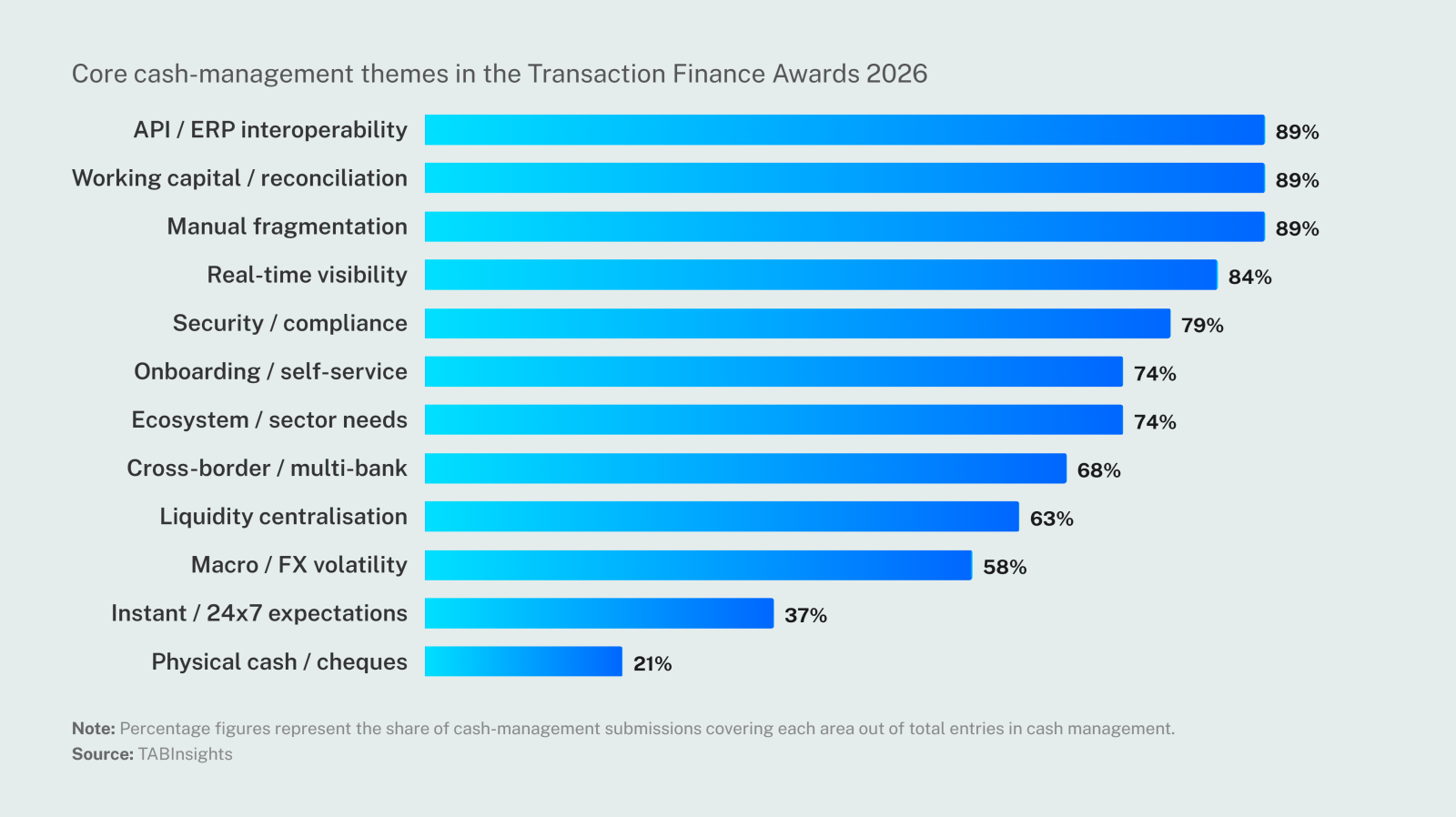
Manual fragmentation, working-capital and reconciliation pressure, and interoperability between application programming interfaces (APIs) and ERP systems were each identified in 89% of the submissions analysed. Real-time visibility and forecasting appeared in 84%, while security, fraud, governance and compliance pressures appeared in 79%.
The findings indicate that cash-management modernisation is becoming an operating-model issue, not simply a matter of improving digital channels. Online payments, reporting and approvals are increasingly baseline capabilities. For banks, the strategic question is where deeper integration can still produce measurable improvements in liquidity, working capital and control.
Cash management moves into corporate systems
Real-time treasury increasingly means more than faster payments or current account information. The emerging model connects banking services directly to corporate systems managing receivables, payables, liquidity and financial reporting. In this analysis, real-time refers to the timely exchange of balance, transaction and status information and, where payment infrastructure permits, immediate execution or settlement.
API, host-to-host (H2H) and ERP integration with straight-through processing was identified as a best practice by 89% of submissions, as were real-time dashboards, forecasting or analytics. Some form of workflow automation appeared in every submission, indicating that its presence alone offers limited differentiation. The more meaningful distinctions lie in the depth of integration and measurable impact.
The distinction between a digital channel and an integrated treasury model is practical. A portal allows a treasurer to view a balance or download a statement. An integrated model allows approved invoices to generate payment instructions, sends transaction statuses back to the ERP and matches incoming receipts against outstanding receivables without repeated data entry.
Kotak Mahindra Bank illustrates the shift towards connected workflows. It reported that its Sampark Setu merchant platform had onboarded more than 7,000 merchants and reduced onboarding turnaround time by 67%. The bank also reported more than 100 enterprise clients connected to its API-based Plutus platform.
Vietcombank combines H2H connectivity for large transaction files with open APIs for real-time exchange across payments, reporting and receivables. According to its submission, the H2H infrastructure can process more than 20,000 transactions per file and has been implemented for nearly 300 large enterprises.
H2H and APIs serve different but complementary needs. H2H remains useful for payment factories, payroll and other high-volume batch processes, while APIs support real-time account enquiries, payment confirmation and receivables notifications. Vietcombank also uses structured incoming-payment data to support allocation and reconciliation inside corporate ERP systems, while automated balance and statement feeds improve cash-position reporting.
In Taiwan, CTBC Bank illustrates the importance of standardised data. It introduced ISO 20022-based APIs for New Taiwan dollar (TWD) and foreign-currency payments, reducing the need for companies to maintain different instruction formats. The bank also used an artificial intelligence (AI)-assisted interface to guide corporate customers through service applications and explain documentation requirements.
APIs themselves are no longer the differentiator. The more useful test is whether connectivity covers the full cash cycle, carries structured data into corporate systems and reduces manual processing.
Multi-currency flows intensify the need for centralised control
ERP connectivity is particularly important in cross-border liquidity management. A central view of cash has limited value unless balances can also be moved within regulatory, currency and legal-entity constraints. Cross-border, regulatory and multi-bank complexity appeared in 68% of submissions, while liquidity centralisation, yield or funding efficiency appeared in 63%. Pooling and liquidity concentration were also widely evidenced in bank propositions, although the submissions provide uneven evidence of client adoption and measurable outcomes.
Pooling structures are also becoming more closely connected to real-time information, FX decisions and internal funding. In its 2026 submission, Bank of America described moving clients towards region-wide pooling and optimisation structures and real-time cash positioning; it separately cited richer ISO 20022 data to improve reconciliation and exception handling. Industrial and Commercial Bank of China’s (ICBC) submission described integrated domestic- and foreign-currency pools, multi-currency notional pooling and global payment tools for managing cross-border liquidity and currency positions.
Bank of Shanghai provided a domestic example: one mandate connected nine banks, 752 accounts and 172 users, combining consolidated visibility with automated cash concentration.
The examples show banks increasingly combining liquidity structures with timely data, automated rules and group-level governance. However, the submissions do not consistently quantify whether these implementations reduced idle balances, improved yield or lowered external funding requirements.
Customisation shifts towards workflow and ecosystem design
In the 2025 Cash Management Survey, customisation was primarily presented as tailoring products to a client’s liquidity structure. In 2026, it extends more directly into industry workflows, corporate ecosystems and operating processes.
Sector- and ecosystem-tailored solutions were evidenced by 79% of submissions, while 74% identified sector-specific or embedded treasury needs as a client trend. This includes solutions designed around property collections, logistics networks, education payments, merchant ecosystems and cash-intensive industries.
United Overseas Bank (UOB) illustrates how customisation is moving from individual products to structures built around client operations. For a Singapore public healthcare organisation, UOB reported implementing a four-tier virtual sub-account structure reflecting the client’s entity hierarchy. About 15 accounts were consolidated into one master account while payment and collection functions remained available at each level. The bank reported improved visibility and control and greater operating efficiency through automation.
DFCC Bank took a workflow-based approach for a Sri Lankan property developer, assigning virtual accounts to customers and projects and sending incoming-payment information directly to the client’s ERP for reconciliation. The bank reported that ERP updates that previously took hours were reflected within seconds. It separately reported that its enhanced liquidity dashboards and forecasting tools improved planning efficiency by more than 30%.
In the Philippines, China Banking Corporation (Chinabank) addressed the needs of sectors that still depend partly on paper and physical cash. Its tax-payment solution automated a paper-based process for property developers, while its Smart Cash Safe solution automated cash validation, storage and reporting for cash-intensive businesses.
These cases show that customisation increasingly means designing around a client’s entity structure, industry workflow and wider commercial ecosystem.
Receivables automation remains uneven
Receivables management was less consistently evidenced than the prevalence of working-capital and reconciliation pressures would suggest. Pressure relating to working capital, collections and reconciliation appeared in 89% of submissions, while virtual accounts or automated receivables and reconciliation were evidenced as best practices in 68% of submissions.
These are not directly equivalent categories: working-capital and reconciliation pressure describes a broad client challenge, while virtual accounts and automated reconciliation represent particular responses. The difference should therefore be read as a directional indication of uneven response maturity rather than a one-to-one gap between client demand and banking capability.
One constraint is that receivables workflows extend beyond the bank into corporate ERP, invoicing and customer-data systems, where incomplete or unstructured remittance information can limit automation. Virtual accounts address part of this problem by identifying the customer, invoice, location or project behind a payment. APIs or H2H connections then carry the data, while ERP and accounts-receivable systems apply matching rules and trigger subsequent actions. Without these connections, the virtual-account structure does not by itself deliver automated cash application.
DFCC Bank’s property-sector implementation demonstrates this end-to-end model. Vietcombank also connected virtual-account structures and receivables APIs with corporate systems to automate the allocation of incoming credits.
Receivables automation presents an additional challenge in sectors that still handle physical cash or cheques. Although physical cash or cheque dependence appeared as a major theme in 21% of submissions, it remains material in retail, logistics and service industries. In these sectors, cash must be validated, credited and reported into the same treasury systems as electronic payments before companies can achieve a consolidated view.
AI and automation emerge as embedded control layers
AI increasingly appears as an enabling technology rather than a stand-alone cash-management proposition. Banks are applying it to forecasting, payment matching, customer support and exception management, but its value in treasury depends on whether the underlying process remains controlled and auditable.
This places greater importance on control. Security, fraud and governance challenges were evidenced by 79% of submissions, while security and governance by design appeared as a best practice in 84% of submissions. As payments and liquidity movements become faster, entitlement management, transaction monitoring and approval controls need to operate at a comparable speed.
The submissions show AI being applied to several defined processes. China Merchants Bank reported using AI and robotic process automation in treasury forecasting and corporate workflows, while Bank of America described AI-enabled forecasting and receivables capabilities. These examples establish deployment, but the submissions do not consistently quantify their impact. CTBC provides a more measurable case: the bank reported that its AI-assisted Smart Application Platform reduced processing time for simple cases from seven days to one, shortened customer decision time by 30% and resolved 86% of enquiries autonomously.
The next stage will be measured by outcomes, not feature roll-outs
Cash-management modernisation is moving beyond the digitisation of individual transactions. Payments, balances, receivables and liquidity decisions are increasingly being connected directly to corporate systems, supported by more timely data and stronger automated controls.
The submissions show broad investment in platforms, ERP connectivity and liquidity centralisation. Receivables processing and cash application were less consistently evidenced, with fragmented data and processes continuing to limit automation. The next stage of progress should therefore be measured not by the number of APIs or transactions processed, but by improvements in automatic matching, exception rates, forecast accuracy and working-capital performance.
Subscribe for regular insights.


Banner.png)



.png)





 Google
  LinkedIn